
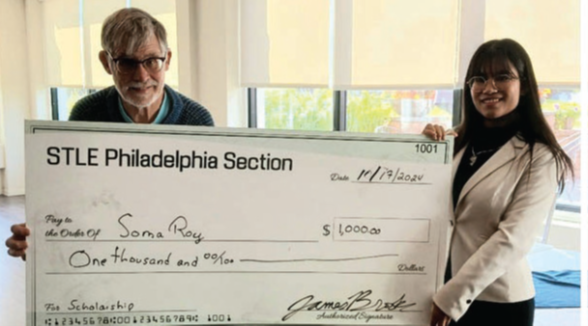
A $1,000 scholarship has been awarded to University of Maryland (UMd) graduate student Soma Roy, working under the direction of Professor Michael Azarian. Roy joined the Azarian group after finishing a project involving design and testing of a novel heat sink for electrical propulsion systems. Since that time, she has been performing research on the use of lubricating oils and greases in polymer-gold contacts to delay the onset of surface degradation due to fretting wear and corrosion. Her work has been providing insight into the role of materials and interfacial chemical factors on friction and wear in lubricated and unlubricated contacts operating at low normal loads. Since these contacts are applicable to micromechanical switches and actuators with lifetimes of over a decade, she has also been investigating the aging of lubricating oils and greases. Furthermore, Roy has undertaken the challenging task of developing a finite element model of the lubricated sliding interface to facilitate exploration of the effect of material properties and loading conditions on the polymer-gold interface.
Roy’s research requires close collaboration with the sponsoring company. The biweekly meetings consist largely of presentations by Roy of her latest findings. This has given her an opportunity to develop strong communication and presentation skills. It has also ensured that her work maintains relevance to practical, industrial applications even while it satisfies the high academic standards of UMd’s graduate program.
Professor Azarian describes Roy as self-motivated, a creative problem solver and a serious researcher. Her fretting tests employ LabVIEW for instrument control and monitoring of load and friction. She has become skilled in the use of Fourier transform infrared spectroscopy (FTIR) and ellipsometry for assessment of lubricant film thickness, chemistry and aging. Her post-test analysis includes the use of optical microscopy, scanning electron microscopy, energy dispersive X-ray spectroscopy and optical profilometry to evaluate contact surface degradation. Azarian cites Roy’s commitment to research and intellectual exploration, as exemplified by her active participation in Azarian’s Design for Reliability class. Her graduate research has demonstrated her ability to translate theoretical knowledge into practical solutions. Azarian states that Roy has a natural curiosity that extends beyond the classroom, and her eagerness to explore new ideas and methodologies reflects her potential for making significant contributions to the field of tribology.