
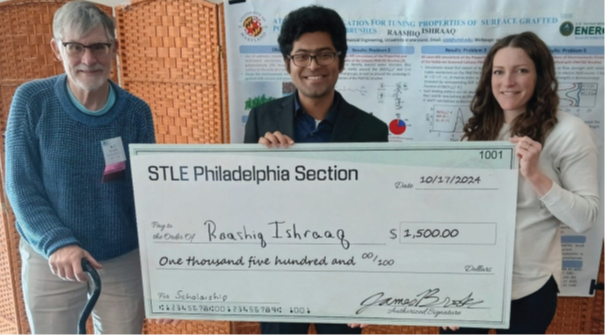
A $1,500 scholarship was awarded to University of Maryland graduate student Raashiq Ishraaq. Working under the direction of Professor Siddhartha Das. Ishraaq’s work involves atomistically modeling grafted polyelectrolyte (PE) brushes and finding the microscopic reason for their high lubricity. PE brushes enhance lubricity between two shearing surfaces by reducing friction. It can also be found in various biological systems as a biolubricant, such as synovial joints (hip, knee and shoulder). Ishraaq’s research has two broad directions: using molecular dynamics simulation to investigate such systems and using machine learning (ML) algorithms to extract useful information for designing better lubricating surfaces.
Recently, Ishraaq has discovered and published (JPCB and Macromolecules) the atomistic mechanism explaining why counterions are loosely bound to PE brushes of certain chemical structures. Moreover, he recently developed a new ML scheme that helps to understand the atomistic picture of such brush systems (published in Macromolecules). The results of these three articles will guide the choice of counterions for synthesizing PE brushes with specific lubricity. Ishraaq’s current investigation deals with finding the effect of various kinds of perturbation (electric, temperature, etc.) on such highly lubricating surfaces, working in conjunction with Dr. Sissi De Beers of the University of Twente. The overarching goal is to improve the current understanding of such systems and also to develop more machine-learning schemes that could be beneficial for future researchers studying various kinds of lubricating surfaces.
As a recognition to his highly successful tenure at the University of Maryland, Ishraaq has won a Future Faculty Fellowship from the University of Maryland’s college of engineering and has published (as a lead author and a co-author) as many as six peer-reviewed papers in top-rated journals. Professor Das notes that apart from his great technical skills, Ishraaq also possesses great leadership qualities. He has mentored a graduate student and a few new doctoral students in the group. Moreover, he is an excellent team worker and has also served as a teaching assistant for multiple courses.